 Our New Center at Manyata Residency, Bengaluru
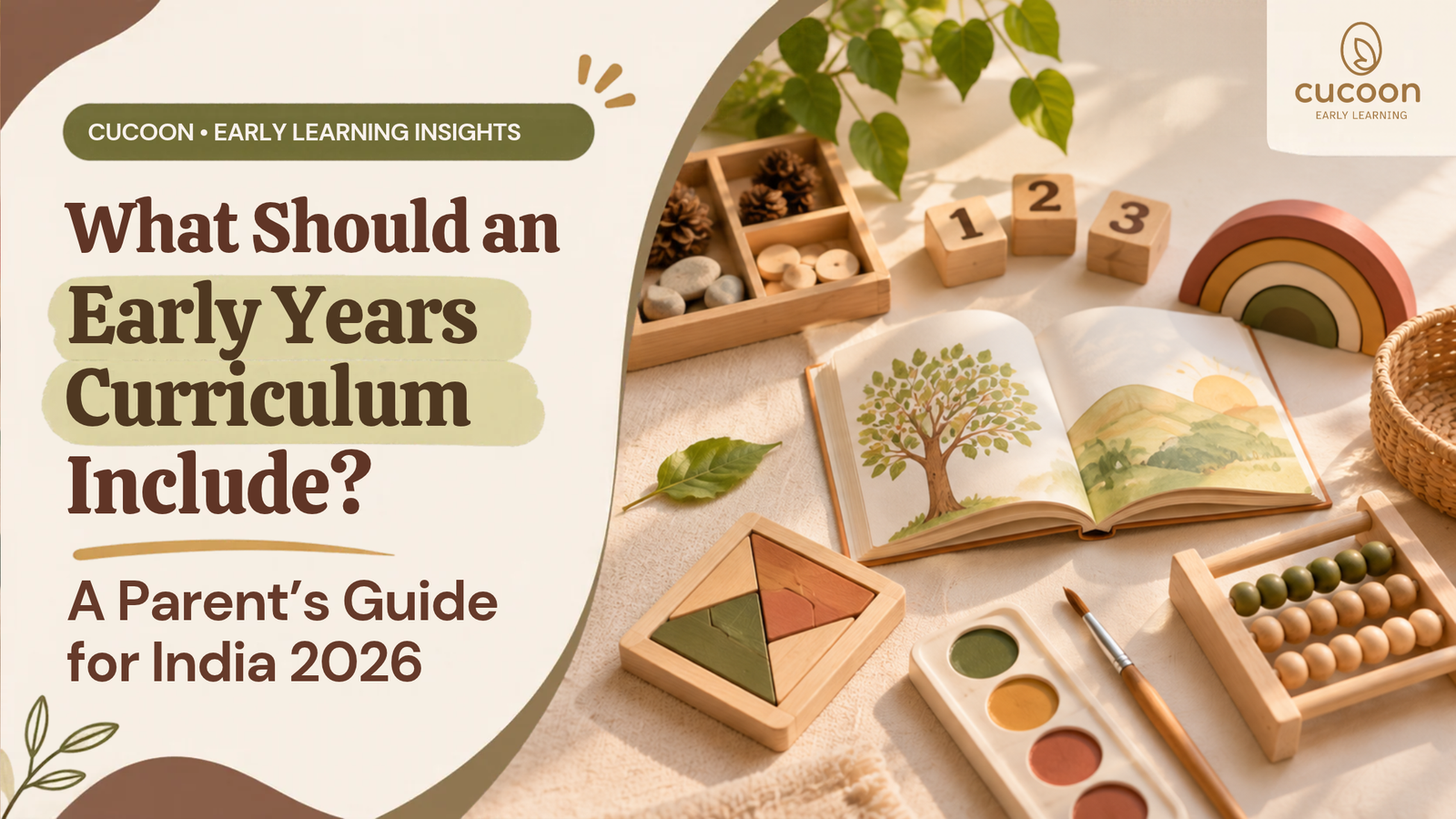
A good early years curriculum for children aged one to six covers five areas of development: physical, social and emotional, thinking, language, and creative and cultural growth. India’s National Curriculum Framework for the Foundational Stage sets out these areas and puts play at the heart of all of them, through building, storytelling, songs and outdoor games, rather than written tests. Cucoon, an early learning centre in Bengaluru, uses the EYFS framework as its root system, with Reggio-inspired exploration, Montessori elements and mindful practice built on top.
Quick Summary
-
India has a national framework. NCERT’s National Curriculum Framework for the Foundational Stage (2022) covers ages three to eight across five areas of development.
-
Play is how children learn. The framework treats play as the main way learning happens at this age.
-
Progress is observed, not tested. Teachers understand each child’s growth by watching them learn and play.
-
The EYFS covers the same ground. It groups learning into seven areas that map closely onto India’s framework.
What does India’s early years framework say?
NCERT’s National Curriculum Framework for the Foundational Stage, published in 2022, sets out what early learning should look like for children aged three to eight. It names five areas of development: physical and motor, socio-emotional and ethical, cognitive, language and literacy, and aesthetic and cultural.
It also describes how learning should happen: through supervised, play-based experiences, in groups and individually, that build curiosity, creativity, cooperation, empathy and communication. A school that shows how its programme covers all five areas through play is following the spirit of the framework.
What do the five areas look like in a real classroom?
| Area of development | What parents might see |
|---|---|
| Physical and motor | Climbing, balancing, running and outdoor time, alongside threading, pouring, cutting and drawing |
| Socio-emotional and ethical | Turn-taking, naming feelings, solving small disagreements with adult support, and routines that help a child settle |
| Cognitive | Sorting, matching, sequencing, building, questions that get explored, and early number sense in everyday contexts |
| Language and literacy | Stories, songs, rhymes, conversations with adults who listen, picture books within reach, and early mark-making |
| Aesthetic and cultural | Open-ended art where the process matters more than the product, music, movement, and festivals and local culture |
How does the EYFS compare?
Cucoon works from the Early Years Foundation Stage, the early years framework used in England for children from birth to five. It sets out seven areas of learning. Three are prime: communication and language, physical development, and personal, social and emotional development. Four are specific: literacy, mathematics, understanding the world, and expressive arts and design.
The overlap with India’s framework is close. The EYFS also places strong emphasis on warm, consistent relationships between children and their educators, and on how children learn: by playing and exploring, staying engaged, and creating and thinking for themselves. The guide to the EYFS curriculum for Indian parents explains it in more depth.
What does a balanced early years day look like?
NCERT’s National Curriculum Framework for School Education (2023) describes learning at the foundational stage as largely play-based, built on concrete materials such as toys, puzzles, picture books and hands-on resources, with teachers understanding progress mainly by observing children.
In practice, a balanced day for young children tends to include:
-
Plenty of play. Both free play and play guided by educators.
-
Hands-on materials. Blocks, puzzles, art supplies and natural objects children can explore.
-
Stories and conversation. Time to listen, talk, ask questions and share ideas.
-
Movement and the outdoors. Daily time to run, climb and explore nature.
-
Early literacy and numeracy woven into play. Letters, sounds and numbers introduced through games, songs and everyday moments.
How is progress shared with parents?
In the early years, progress is best understood through observation: educators noticing and recording what each child does across the five areas over time, and sharing it in a way that describes the child’s own growth.
How does Cucoon’s curriculum work in practice?
Cucoon’s approach uses the EYFS as its root system, with Reggio-inspired exploration and project-based discovery, Montessori elements for independence and practical life skills, and mindful education for empathy, resilience and emotional awareness. Three pillars hold it together: attachment, because secure relationships are where learning begins; autonomy, because children learn best when they lead; and attunement, because to teach well is to listen well.
The year runs on themes rather than separate subjects, including Monsoon Magic, Festivals of Light, Growing Gardens, Colours of Culture and Community Connections. Themes let children explore all five areas together, in ways that feel connected and meaningful. Parents can see how each programme stage builds on the last when they book a campus visit.
Frequently asked questions
- What should an early years curriculum include in India?
- It should cover the five areas in India’s National Curriculum Framework for the Foundational Stage: physical and motor, socio-emotional and ethical, cognitive, language and literacy, and aesthetic and cultural development, all delivered through play.
- Is there a national early years curriculum framework in India?
- Yes. NCERT published the National Curriculum Framework for the Foundational Stage in 2022, covering children aged three to eight. Schools build their own programmes on its areas of development and play-based approach.
- How is progress understood in the early years?
- Mainly through observation. Educators watch how children play, explore and interact, keep a record of their growth and share it with parents.
- What is the difference between the EYFS and India’s framework?
- They cover the same ground in different ways. India’s framework names five areas of development; the EYFS names seven areas of learning, split into three prime and four specific. Both put play at the centre.
- How can parents learn about a school’s curriculum?
- Ask which framework the school follows and how it shapes a typical week, ask to see the term or theme plan, and ask how progress is observed and shared with parents.