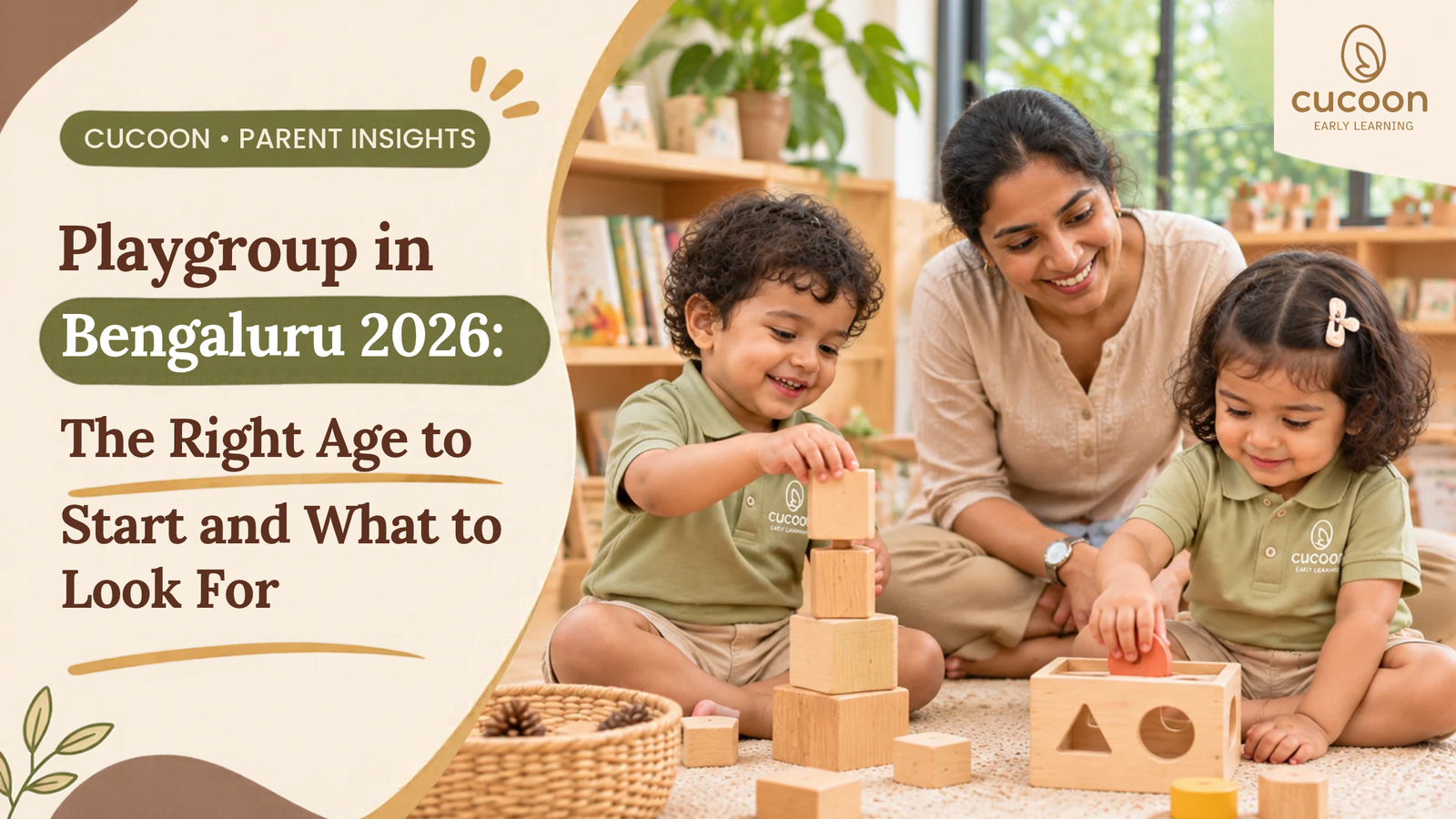
Playgroup in Bengaluru usually begins at around two years, when a child can manage a short time away from a parent, play alongside other children and follow a simple daily rhythm. Readiness matters more than an exact birthday. At Cucoon, an early learning centre in Whitefield, the playgroup-stage programme is Wiggles, for children aged two to three.
Quick Summary
The usual starting point is around two. Cucoon’s Wiggles programme runs from two to three, with a gentler Nest programme from one to two.
Readiness is not about academics. It is about separating comfortably, playing near other children and managing a short routine away from home.
A good playgroup balances two kinds of play: play the child leads and play adults guide, in a calm and safe environment.
On a visit, look at three things: how children are helped to settle, how the day is shaped, and how the team keeps parents informed.
What age does playgroup usually start?
Playgroup is the stage between the toddler years and nursery, and in most Bengaluru settings it begins at around two.
Age is a guide rather than a rule. A child who is ready can usually manage a short separation from a parent, show interest in other children even if they mostly play alongside them, communicate needs in some form, and settle into a predictable routine.
For families who want to start earlier, Cucoon’s Nest programme for one to two year olds is built around secure relationships, comforting routines and simple sensory experiences in small groups.
What should parents look for in a playgroup?
Cucoon’s approach is rooted in the Early Years Foundation Stage (EYFS), the early years framework used in England for children from birth to five. Its principles make a useful checklist for any setting:
Warm, consistent relationships. Educators who get to know each child closely once they join, help them settle and stay in touch with parents.
Play the child leads and play adults guide. A good day includes both.
Curious, engaged children. Children exploring, having a go, concentrating and coming up with their own ideas.
The basics first. At playgroup age, communication, movement and emotional security matter more than letters or numbers.
Wiggles, Cucoon’s programme for two year olds, nurtures holistic development through the seven pillars of the EYFS framework and Reggio Emilia-inspired learning. The focus is on movement, choice and first independence, building connection and providing a safe environment rather than formal instruction.
Children build vocabulary through songs and stories, make simple choices and follow their interests, form first friendships, develop fine and gross motor skills, and start noticing colours, textures, patterns and sounds.
The environment does part of the work. Cucoon’s rooms are organised into age-appropriate zones, including a literacy corner with books and storytelling prompts, an open studio for drawing and painting, a role-play space, a mud kitchen for nature play, and a quiet rest room with soft light for napping at a child’s own pace. The approach behind these spaces uses quiet colours, natural textures and open layouts that help children feel calm rather than overstimulated.
What should parents ask on a campus visit?
Which educators will my child spend the day with, and how will I hear from them?
How do you help a child who cries at drop-off settle in, and over how many days?
How much of the day does a child get to choose?
What happens if my child is unwell or has a small accident?
How will I know what my child did each day?
Visits to Cucoon in Whitefield can be booked through the admissions page.
Frequently asked questions
What is the right age to start playgroup in Bengaluru?
Playgroup usually starts at around two years. What matters more than the exact age is whether a child can manage a short separation, shows interest in other children, communicates needs in some form and settles into a simple routine. Cucoon’s Wiggles programme covers ages two to three.
Do I have to wait for my child to be 2 years old to start?
No. Cucoon’s Nest programme welcomes children from one to two years, with a focus on secure relationships, calm routines and simple sensory play in small groups. It suits a child who is still very new to being away from home.
What is the Wiggles programme at Cucoon?
Wiggles is Cucoon’s programme for two year olds. It nurtures holistic development through the seven pillars of the EYFS framework and Reggio Emilia-inspired learning, with a focus on movement, choice, first friendships and a safe, connected environment.
What should I look for when visiting a playgroup?
Look for educators who will get to know your child, a mix of child-led and adult-guided play, an environment that calms rather than overstimulates, and clear daily communication with parents. At this age, communication, movement and emotional security matter more than early letters or numbers.
Where is Cucoon located in Bengaluru?
Cucoon is in Whitefield, Bengaluru. Programmes run from Nest at one to two years through to Butterfly at five to six years, and campus visits can be booked through the admissions page.
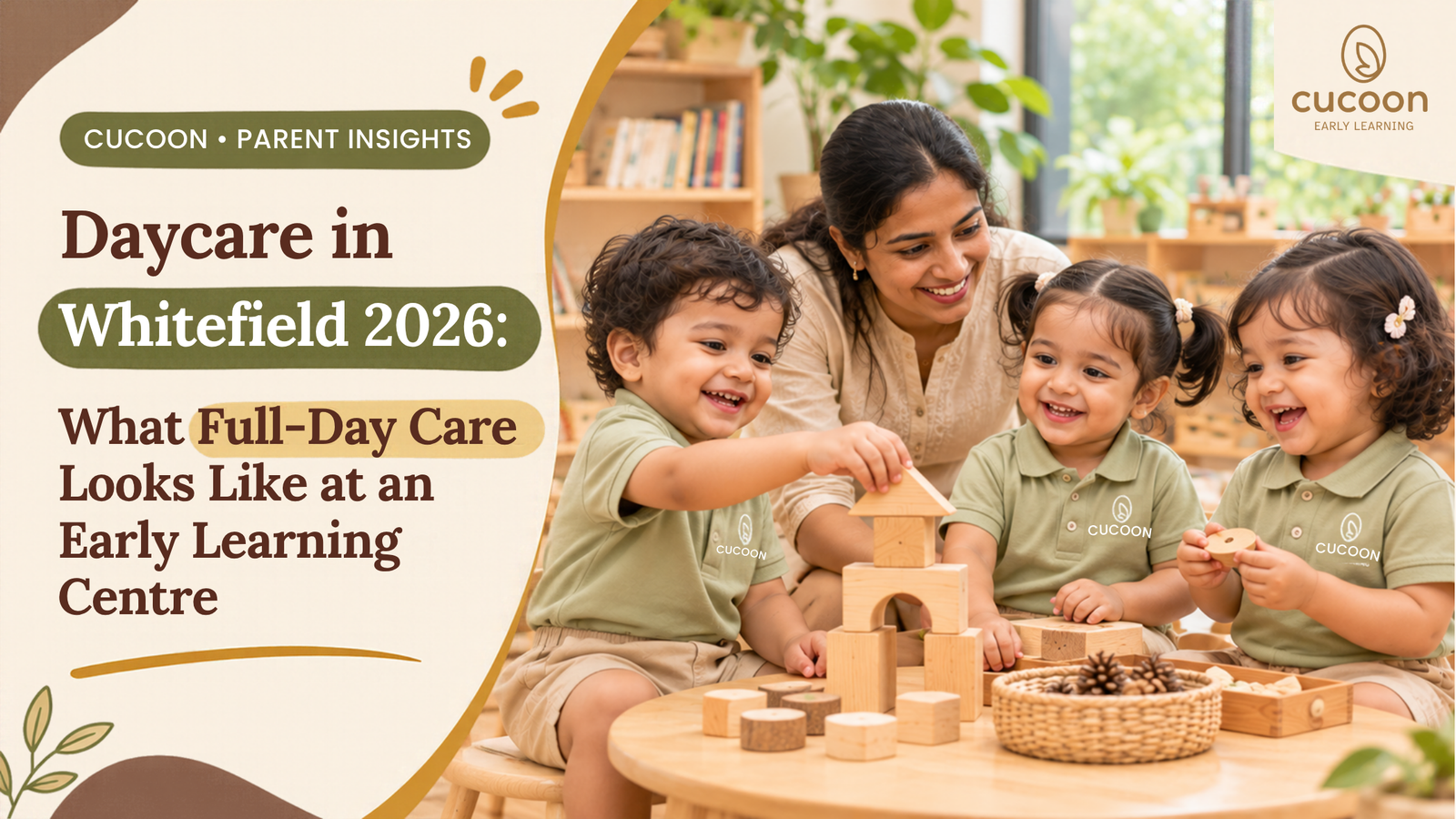
Good daycare in Whitefield should feel like the same early years programme carried through a longer day, not a separate minding service that starts when the learning stops. A full day is built on a settled routine, familiar caregivers, proper rest and unhurried transitions between activity and quiet time. Cucoon, an early learning centre in Whitefield, welcomes children from one to six and offers extended day care for working parents, with a dedicated rest space for napping.
Quick Summary
One programme, all day. A good setting plans the afternoon with the same care as the morning.
Rest is part of the day. A calm, dedicated space for napping matters for younger children.
Familiar faces. At Cucoon, children who stay on for day care remain with familiar caregivers after lunch, so there is no handover to new faces.
Plan around the commute. Whitefield traffic makes pickup times worth discussing before enrolling.
What does full-day care at an early learning centre mean?
There are two kinds of service offered under the word daycare. One is mainly supervision: a safe room, an adult present and hours that suit a working parent. The other is a full-day early years programme, where learning and care are one continuous experience and the afternoon is planned as thoughtfully as the morning.
Cucoon is built around the second. It shows up in a few clear ways:
A real rhythm. Active play, focused activity, meals, rest and quiet time in a sequence the child can predict.
Rest treated properly. A dedicated space and enough time for a child who still naps.
Gentle transitions. The moments between activities are where young children find things hardest, and where a well-run day is easiest to spot.
Why does the length of the day matter in Whitefield?
Whitefield is home to many working parents, and the commute is often their biggest constraint. A short morning programme can be hard to manage when both parents travel to work, and a pickup time that assumes an easy drive can become a daily worry. A longer, well-planned day gives families breathing room, and gives children a calm, consistent day rather than a rushed one.
What should a good full day include?
Cucoon’s approach is rooted in the Early Years Foundation Stage (EYFS), the early years framework used in England for children from birth to five. Its principles give parents a useful guide for judging any full-day setting:
Warm, consistent relationships. Familiar educators who know each child well, help them feel secure and keep parents informed. Over a longer day, this matters even more.
Both kinds of play. Children learn by leading their own play and by joining play guided by adults. A good afternoon includes both.
Engaged, curious children. Playing and exploring, concentrating and trying again, and coming up with their own ideas.
How is a day at Cucoon built?
Cucoon’s programmes run in five stages, from Nest at one to two years, through Wiggles, Caterpillar and Chrysalis, to Butterfly at five to six. Educators follow each child’s lead while keeping enough structure for children to feel secure, and the daily rhythm balances structured moments with open exploration.
The rooms are organised into age-appropriate zones, and two matter especially over a longer day. The Dream Room is a rest space with soft light, muted tones and quiet rhythms, where children wind down and nap at their own pace. The mud kitchen and nature zone gives children outdoor, physical play before they settle again. Around them sit the story corner, the art studio and the role-play space.
The design follows a sensory-led philosophy, set out in the Cucoon approach: quiet colours, natural textures, open layouts and soft rhythms that help children stay calm rather than overstimulated. Over a full day, that calm makes a real difference to how a child feels at pickup time.
Timings at the Whitefield centre depend on the stage a child is joining, and can be confirmed when families book a visit.
What should parents ask before enrolling for a full day?
What are the exact hours, and what is the latest pickup time?
What does the afternoon include, activity by activity?
Who will be with my child in the afternoon?
Where do children rest, and for how long?
What happens if I am running late?
How will I hear about my child’s day?
Frequently asked questions
What does full-day care at an early learning centre include?
It should include the same early years programme as the shorter day, extended with meals, a proper rest period, outdoor play and unhurried transitions, with familiar caregivers throughout.
Does Cucoon offer daycare in Whitefield?
Yes. Cucoon offers extended day care for working parents at its Whitefield centre, supervised by its own team, and its rooms include the Dream Room, a dedicated rest space for napping. Timings depend on the stage a child is joining and can be confirmed with the centre.
What age can a child start full-day care?
Readiness matters more than age. A child who can separate comfortably, follow a simple routine and settle to sleep away from home will manage a longer day. Cucoon’s stages begin at one to two years with Nest, built around secure relationships and calm routines.
Should full-day care include a nap?
Yes, for children who still nap. A dedicated, calm rest space and enough time to sleep are an important part of a good full day for younger children.
How can parents judge a full-day early years setting?
Look for familiar educators who know the child well, a mix of child-led and adult-guided play, a calm environment, a proper rest space, and clear daily communication with parents.
Cucoon, an early learning centre in Bengaluru, welcomes children aged one to six across five stages, from Nest at one to two years to Butterfly at five to six. Admission follows five simple steps: an enquiry and campus tour, a parent interaction with educators, the application, a relaxed playdate for the child, and confirmation with a welcome letter. Cucoon has two centres, in Whitefield and at Manyata Residency, and both are now taking admissions.
Quick Summary
Ages one to six in five stages, so many children join partway through rather than at the start.
Five steps, two of them in person: the campus tour and the playdate.
No rush: admissions are open through the year, subject to availability in each stage.
Two centres: Whitefield and Manyata Residency are both open and taking admissions.
Which stage will my child join at Cucoon?
Cucoon’s programmes run in five stages, each built around what children need at that age.
Stage
Age
What the stage is built around
Nest
1 to 2 years
Secure relationships, comforting routines and simple sensory experiences
Wiggles
2 to 3 years
Movement, choice and first independence through songs, stories and messy play
Reading and writing readiness, early number concepts, problem-solving
Butterfly
5 to 6 years
Independent thinking, collaboration, phonics and numeracy through projects
When enquiring, parents can share their child’s age and the stage they have in mind, and the team will help confirm the right fit. If a child’s age is close to the line between two stages, it helps to mention this during the tour, because the right stage depends on the child’s development as much as on their birthday.
What are the five steps in the Cucoon admissions process?
Enquiry and campus tour. Families start with a conversation, through the form on the admissions page or by phone, followed by a visit to see the learning spaces.
Parent interaction. Parents spend time with the educators to understand how Cucoon supports each child’s growth. This is a good moment for any questions.
Application. Parents complete and submit the application form.
Playdate. The child visits for a relaxed play session.
Confirmation and welcome letter. The child’s place is confirmed and the family receives its welcome materials.
Cucoon also shares an admissions kit with a welcome letter, a curriculum overview, the daily rhythm, a philosophy booklet and highlights from the parent handbook.
How long does admission take?
Admissions at Cucoon are open through the year, subject to availability in each stage, so there is no need to rush. Families are welcome to enquire, visit and take the time they need before deciding. As the process includes a tour, a parent interaction and a playdate, it usually takes a few weeks from first enquiry to a confirmed place.
A few questions worth asking in the first conversation:
When does the next batch for my child’s stage begin?
Is a place available now in my child’s stage?
How long does the process usually take from enquiry to confirmation?
What happens at the playdate?
The playdate is a relaxed visit for the child, not an assessment. It gives children a chance to explore the space, play and meet the educators before they start, so that their first day feels familiar and comfortable.
The parent interaction is a good time to learn how Cucoon’s approach and its three pillars, attachment, autonomy and attunement, shape a child’s day.
What should parents know about safety and daily care?
Safety. Premises are child-proofed, CCTV-monitored and access-controlled, with background checks and child-safeguarding training for staff, secure entry and exit, and trained first-aid responders.
Educators. Teachers are graduates, ideally with a diploma or certification in early childhood education, and receive continuing training in EYFS practice.
Small groups. Group sizes are kept small so each child gets individual attention.
Meals. Meals and snacks are provided, with dietary needs accommodated where possible.
Extended care. Extended day care is available for working parents, supervised by the same team.
Screens. The focus is on hands-on exploration, with technology used mainly for parent communication.
Which Cucoon centre is closer to home?
Cucoon has two centres in Bengaluru. The Whitefield centre serves families in east Bengaluru, and the Manyata Residency centre has been inaugurated and is taking admissions for families in north Bengaluru. Families can choose the centre that suits them best when they enquire.
Frequently asked questions
What age groups does Cucoon admit?
Cucoon welcomes children from one to six years across five stages: Nest for one to two years, Wiggles for two to three, Caterpillar for three to four, Chrysalis for four to five, and Butterfly for five to six.
What is the Cucoon admissions process?
There are five steps: an enquiry and campus tour, a parent interaction with educators, the application, a relaxed playdate for the child, and confirmation with a welcome letter.
When should I apply to Cucoon?
Admissions are open through the year, subject to availability in each stage, so families can enquire whenever they are ready and ask when the next batch for their child’s stage begins.
Does Cucoon have an entrance test?
No. The playdate is simply a relaxed visit for the child to explore the space, play and feel comfortable before starting.
Does Cucoon offer daycare or extended hours?
Yes. Cucoon offers extended day care for working parents, supervised by its own team. The exact hours for each stage can be confirmed during the admissions conversation.
Which Cucoon centre should I apply to?
Cucoon has two centres in Bengaluru, in Whitefield and at Manyata Residency, and both are taking admissions. Families can choose the centre closer to home when they enquire.
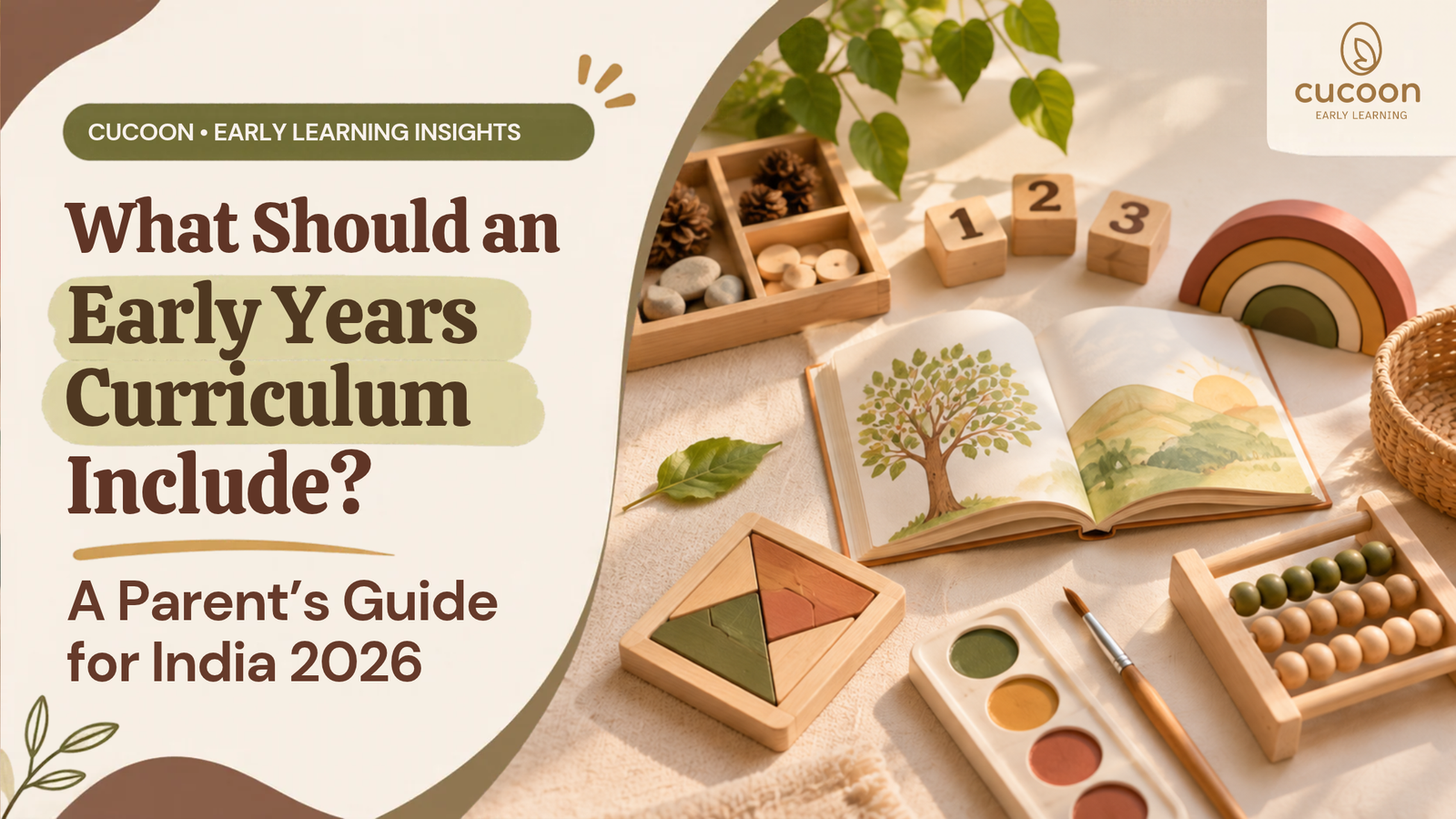
A good early years curriculum for children aged one to six covers five areas of development: physical, social and emotional, thinking, language, and creative and cultural growth. India’s National Curriculum Framework for the Foundational Stage sets out these areas and puts play at the heart of all of them, through building, storytelling, songs and outdoor games, rather than written tests. Cucoon, an early learning centre in Bengaluru, uses the EYFS framework as its root system, with Reggio-inspired exploration, Montessori elements and mindful practice built on top.
Quick Summary
India has a national framework. NCERT’s National Curriculum Framework for the Foundational Stage (2022) covers ages three to eight across five areas of development.
Play is how children learn. The framework treats play as the main way learning happens at this age.
Progress is observed, not tested. Teachers understand each child’s growth by watching them learn and play.
The EYFS covers the same ground. It groups learning into seven areas that map closely onto India’s framework.
What does India’s early years framework say?
NCERT’s National Curriculum Framework for the Foundational Stage, published in 2022, sets out what early learning should look like for children aged three to eight. It names five areas of development: physical and motor, socio-emotional and ethical, cognitive, language and literacy, and aesthetic and cultural.
It also describes how learning should happen: through supervised, play-based experiences, in groups and individually, that build curiosity, creativity, cooperation, empathy and communication. A school that shows how its programme covers all five areas through play is following the spirit of the framework.
What do the five areas look like in a real classroom?
Area of development
What parents might see
Physical and motor
Climbing, balancing, running and outdoor time, alongside threading, pouring, cutting and drawing
Socio-emotional and ethical
Turn-taking, naming feelings, solving small disagreements with adult support, and routines that help a child settle
Cognitive
Sorting, matching, sequencing, building, questions that get explored, and early number sense in everyday contexts
Language and literacy
Stories, songs, rhymes, conversations with adults who listen, picture books within reach, and early mark-making
Aesthetic and cultural
Open-ended art where the process matters more than the product, music, movement, and festivals and local culture
How does the EYFS compare?
Cucoon works from the Early Years Foundation Stage, the early years framework used in England for children from birth to five. It sets out seven areas of learning. Three are prime: communication and language, physical development, and personal, social and emotional development. Four are specific: literacy, mathematics, understanding the world, and expressive arts and design.
The overlap with India’s framework is close. The EYFS also places strong emphasis on warm, consistent relationships between children and their educators, and on how children learn: by playing and exploring, staying engaged, and creating and thinking for themselves. The guide to the EYFS curriculum for Indian parents explains it in more depth.
What does a balanced early years day look like?
NCERT’s National Curriculum Framework for School Education (2023) describes learning at the foundational stage as largely play-based, built on concrete materials such as toys, puzzles, picture books and hands-on resources, with teachers understanding progress mainly by observing children.
In practice, a balanced day for young children tends to include:
Plenty of play. Both free play and play guided by educators.
Hands-on materials. Blocks, puzzles, art supplies and natural objects children can explore.
Stories and conversation. Time to listen, talk, ask questions and share ideas.
Movement and the outdoors. Daily time to run, climb and explore nature.
Early literacy and numeracy woven into play. Letters, sounds and numbers introduced through games, songs and everyday moments.
How is progress shared with parents?
In the early years, progress is best understood through observation: educators noticing and recording what each child does across the five areas over time, and sharing it in a way that describes the child’s own growth.
How does Cucoon’s curriculum work in practice?
Cucoon’s approach uses the EYFS as its root system, with Reggio-inspired exploration and project-based discovery, Montessori elements for independence and practical life skills, and mindful education for empathy, resilience and emotional awareness. Three pillars hold it together: attachment, because secure relationships are where learning begins; autonomy, because children learn best when they lead; and attunement, because to teach well is to listen well.
The year runs on themes rather than separate subjects, including Monsoon Magic, Festivals of Light, Growing Gardens, Colours of Culture and Community Connections. Themes let children explore all five areas together, in ways that feel connected and meaningful. Parents can see how each programme stage builds on the last when they book a campus visit.
Frequently asked questions
What should an early years curriculum include in India?
It should cover the five areas in India’s National Curriculum Framework for the Foundational Stage: physical and motor, socio-emotional and ethical, cognitive, language and literacy, and aesthetic and cultural development, all delivered through play.
Is there a national early years curriculum framework in India?
Yes. NCERT published the National Curriculum Framework for the Foundational Stage in 2022, covering children aged three to eight. Schools build their own programmes on its areas of development and play-based approach.
How is progress understood in the early years?
Mainly through observation. Educators watch how children play, explore and interact, keep a record of their growth and share it with parents.
What is the difference between the EYFS and India’s framework?
They cover the same ground in different ways. India’s framework names five areas of development; the EYFS names seven areas of learning, split into three prime and four specific. Both put play at the centre.
How can parents learn about a school’s curriculum?
Ask which framework the school follows and how it shapes a typical week, ask to see the term or theme plan, and ask how progress is observed and shared with parents.
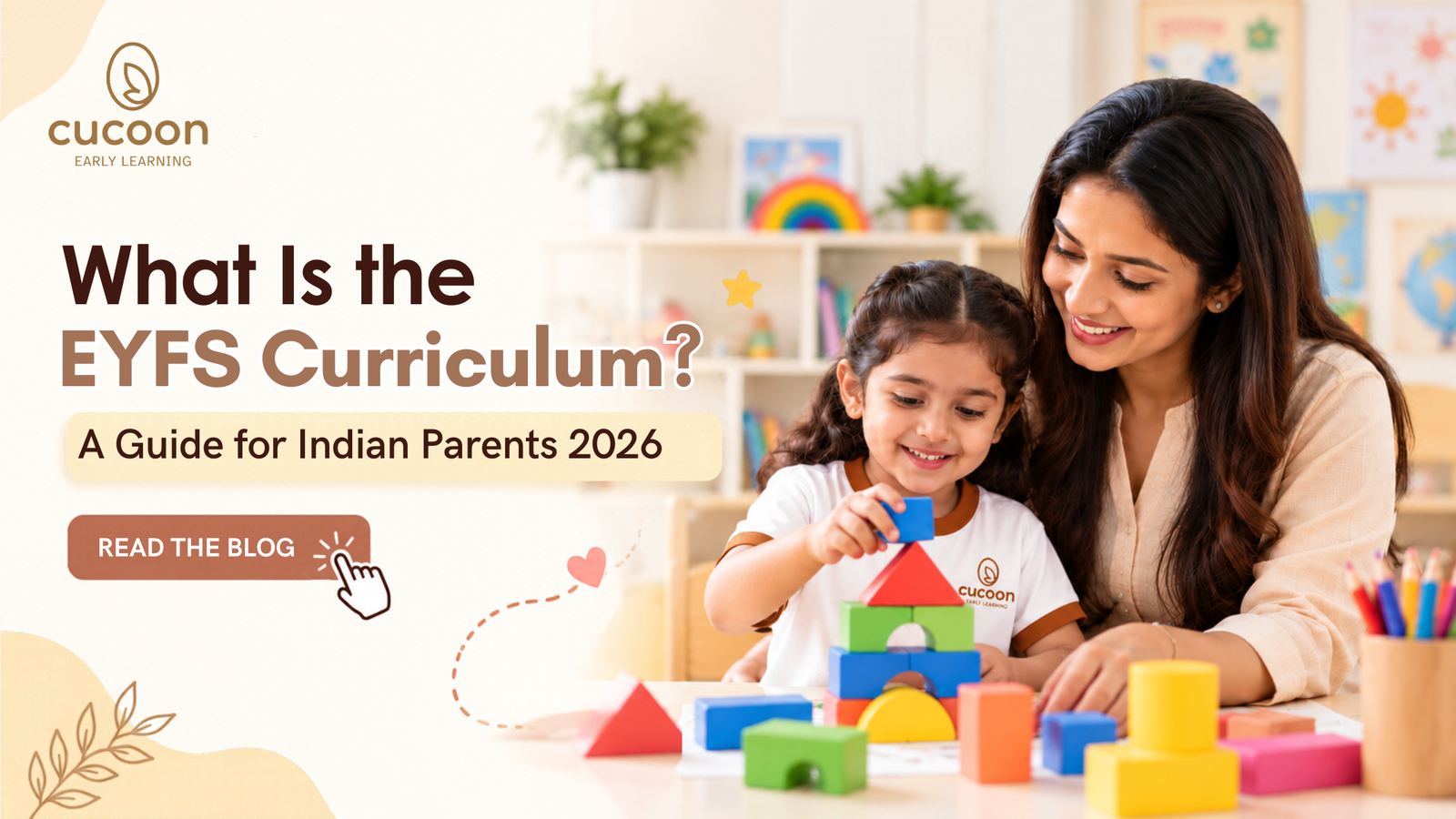
The EYFS curriculum, short for the Early Years Foundation Stage, is the statutory early years framework in England, published by the UK Department for Education, that sets the standards for the learning, development and care of children from birth to five. It is organised around seven areas of learning, delivered mainly through play, and it is used by a growing number of Indian preschools that follow a British early years approach. In India it sits alongside the government’s own National Curriculum Framework for the Foundational Stage, which covers children aged three to eight.
TL;DR
The EYFS is England’s legal framework for early years education, set by the Department for Education, covering children from birth to age five.
Its current version took effect on 1 September 2025 and replaced the 2024 edition, so the version year matters when parents compare schools.
Learning is organised into seven areas, three prime and four specific, taught through play rather than formal instruction.
India’s own foundational framework, the NCF for the Foundational Stage launched in 2022, covers ages three to eight and shares the EYFS emphasis on play-based learning.
AtCucoon in Whitefield, Bengaluru, the EYFS framework is the root of the curriculum, blended with Reggio Emilia and Montessori influences.
What is the EYFS curriculum?
The EYFS curriculum is the statutory Early Years Foundation Stage framework that sets the standards every early years provider in England must meet for the learning, development and care of children from birth to five. It is published by the UK Department for Education, and itscurrent statutory framework took effect on 1 September 2025, replacing the 2024 edition. The framework was first introduced in 2014 and is updated periodically, which is why the version year is worth checking when parents compare preschools.
EYFS stands for Early Years Foundation Stage. It is not an exam syllabus or a fixed set of lessons. Instead it defines what children should be helped to learn, how their progress is checked, and the safeguarding and welfare standards a setting must uphold. The framework is clear that it does not prescribe a single teaching method, and it treats play as essential to how young children learn.
Because the EYFS is a recognised international early years standard, preschools outside England, including several in India, adopt it as their curriculum framework. For Indian parents, understanding the EYFS makes it far easier to compare a British-style preschool against a more conventional academic one.
What are the seven areas of learning in the EYFS?
The EYFS is built on seven areas of learning and development, split into three prime areas and four specific areas. The three prime areas come first because they underpin everything else, and the four specific areas build on that base as a child grows.
Area type
Areas of learning
What it covers
Three prime areas
Communication and language; Physical development; Personal, social and emotional development
The foundations for thriving, forming relationships, and learning in every other area
Four specific areas
Literacy; Mathematics; Understanding the world; Expressive arts and design
Knowledge and skills that strengthen and apply the prime areas
Under theDepartment for Education framework, the three prime areas are treated as the priority for the youngest children, because strong language, physical, and emotional foundations make everything else possible. The four specific areas, including early literacy and mathematics, then give children a broad curriculum that applies and extends those foundations. All seven areas are treated as connected, not as separate school subjects.
What principles and characteristics shape EYFS teaching?
Four guiding principles shape every EYFS setting. The framework holds that every child is a unique child who is constantly learning, that children become strong and independent through positive relationships, that they learn well in enabling environments with responsive adult support, and that the importance of learning and development runs through it all because children develop at different rates.
The EYFS also names three characteristics of effective teaching and learning: playing and exploring, active learning, and creating and thinking critically. In practice this means a strong EYFS classroom looks less like rows of desks and more like guided play, where children investigate, keep trying when something is hard, and form their own ideas.
How is a child’s progress assessed under the EYFS?
Assessment in the EYFS is observation-based rather than test-heavy. Practitioners carry out a short written progress check when a child is aged two, focused on the three prime areas, and share it with parents. In England, reception classes also complete a brief Reception Baseline Assessment in a child’s first weeks at school.
At the end of the reception year, teachers complete the Early Years Foundation Stage Profile, judging each child against the early learning goals and their readiness for Year 1. The framework is explicit that this rests on a teacher’s professional knowledge of the child, with no requirement to gather piles of written or photographic evidence. For parents, the takeaway is that EYFS progress is tracked through everyday observation, not through pressure-based exams.
Does the EYFS curriculum apply in India?
The EYFS is England’s framework, so it is not a legal requirement in India. It runs in Indian preschools as an adopted international curriculum, usually because parents want a play-based, globally recognised early years approach. India also has its own parallel framework: the National Curriculum Framework for the Foundational Stage.
TheNational Curriculum Framework for the Foundational Stage, launched by the Ministry of Education in October 2022, is India’s first integrated curriculum framework for children aged three to eight. It flows from the National Education Policy 2020 and its 5+3+3+4 structure, which places early childhood care and education at the base of school education. Like the EYFS, the Indian framework puts play at the centre of learning and aims to build foundational literacy and numeracy.
The practical point for parents is that the EYFS and India’s foundational framework pull in the same direction. Both treat the early years as developmental rather than academic, both prioritise play, and both cover overlapping ages. A well-run EYFS preschool in India is therefore working in step with the country’s own early years goals, not against them.
How does an EYFS preschool work in practice? The Cucoon example
At Cucoon, a preschool in Whitefield, Bengaluru, the EYFS framework is the starting point for the whole curriculum. Cucoon describes the EYFS as theroot system of its approach, enriched with the creativity of Reggio Emilia, the independence of Montessori, and the calm focus of mindful education, an approach it organises around attachment, autonomy, and attunement.
Cucoon’s programs also show how the seven EYFS areas map onto real classrooms. Its stages, named from Nest through to Butterfly, run from age one to six, andeach of its programs lists the EYFS areas of learning it focuses on, from personal, social and emotional development in the youngest room to literacy and mathematics as children approach school age. In keeping with a play-based model, Cucoon keeps its groups small with a high adult-to-child ratio, and paces learning to the child rather than to a timetable, an idea it explores in its writing onunderstanding the child before teaching the child.
For parents weighing up a British early years curriculum, an EYFS preschool should feel warm, unhurried, and rich in play, while still building the language, motor, and early literacy foundations children carry into formal school. Families who want to see how this works day to day canplan a visit and watch guided play in action.
Frequently asked questions
Frequently asked questions
Is the EYFS the same as the British curriculum?
The EYFS is the early years part of the British education system, covering birth to five. It is set by the UK Department for Education and applies before the primary school years, so it is the foundation stage that comes before the wider British or Cambridge curriculum a child might follow later. In everyday use, “British curriculum preschool” and “EYFS preschool” usually mean the same thing.
What ages does the EYFS curriculum cover?
The EYFS covers children from birth to five years old, ending when a child finishes the reception year in England. In an Indian preschool that follows the EYFS, this usually maps onto the toddler, nursery, and kindergarten years, roughly ages one or two up to five or six. The exact age bands depend on how each school structures its programs.
Is the EYFS recognised in India?
The EYFS is an English framework, so it carries no legal status in India, where early education is guided by the National Education Policy 2020 and the National Curriculum Framework for the Foundational Stage. Indian preschools adopt the EYFS by choice as an international curriculum. Because both frameworks are play-based and cover overlapping ages, an EYFS preschool in India works in line with the country’s own foundational goals.
Does an EYFS preschool mean my child will not learn reading and writing?
No. The EYFS includes literacy and mathematics as two of its four specific areas of learning, so early reading, writing readiness, and number skills are built in. The difference is timing and method: these skills are introduced through play, stories, and conversation rather than through worksheets and rote drilling, and they build gradually on the communication and language foundations laid earlier.
How is a child assessed in an EYFS setting?
Assessment is observation-based. Practitioners note what a child can do during everyday play, complete a written progress check around age two, and, in England, complete the Early Years Foundation Stage Profile at the end of the reception year against the early learning goals. There are no formal exams, and teachers are not required to keep large evidence folders to justify their judgements.
How can I tell if a preschool genuinely follows the EYFS?
Ask the school which version of the EYFS framework it works from, how it covers the seven areas of learning, and how it assesses progress. A genuine EYFS setting will talk about play-based learning, the prime and specific areas, and observation-based assessment rather than heavy homework or early formal testing. Seeing the classroom, where guided play should be visible, is the clearest test.
A premium preschool is worth it in India when the higher fee actually buys higher quality, meaning better-trained educators, smaller groups, warmer individual attention, and a well-designed learning environment, rather than only a smarter-looking building. Research on early childhood education is consistent that quality, not price, is what improves a child’s development, and India’s private preschool sector is largely unregulated, so a high fee on its own is no guarantee. The honest way to decide is to look past the price tag at what the fee pays for, and judge whether those quality markers are present and matter for your child.
TL;DR
A premium preschool is worth paying for when the fee buys real quality inputs, not just premium branding or facilities.
Early years quality has two parts: structural quality (educator qualifications, adult-to-child ratios, group size, physical space) and process quality (the warmth of daily interactions).
Higher-quality preschools are linked to better school readiness, according to peer-reviewed research on Indian preschools.
India’s private preschool market is largely unregulated, so price alone does not guarantee quality and parents must check the markers themselves.
At Cucoon in Whitefield, Bengaluru, the fee reflects heart-led educators, small groups, curated sensory-rich spaces, and an EYFS-rooted curriculum.
Is a premium preschool worth it in India?
A premium preschool is worth it in India when the extra fee pays for higher quality, and it is not worth it when the fee only pays for a nicer building or a well-known name. Decades of early childhood research show that the quality of a preschool, rather than its price, is what shapes a child’s learning and development. The OECD, in its 2025 report on early childhood education and care, finds that stronger structural conditions such as favourable adult-to-child ratios let staff give children more individual attention and build richer relationships, which improves the daily quality of learning.
The complication in India is regulation. The private preschool sector is largely unregulated, so quality varies enormously from one setting to the next. Because no external body guarantees a standard, the price a preschool charges is not a reliable signal of the quality inside it. That is exactly why “what you pay for” is the right question, and why the rest of this guide breaks the fee down into the things that genuinely affect a child.
What actually makes a preschool premium? What you pay for
A genuinely premium preschool charges more because it invests in the inputs that drive quality, and those inputs cost money to provide. Researchers describe early years quality in two layers: structural quality, which covers educator qualifications, adult-to-child ratios, group size, and the physical setting, and process quality, which is the warmth and richness of the everyday interactions between educators and children. High structural quality is what makes high process quality possible.
Here is what a premium fee should actually be buying.
What the fee pays for
Why it matters for your child
Trained, well-supported educators
Educator qualifications and professional development are among the strongest drivers of early years quality, shaping the warmth and depth of daily interactions
Small groups and a favourable adult-to-child ratio
Fewer children per adult means more individual attention, closer relationships, and less time lost to crowd control
A safe, well-designed physical environment
The space, materials, and safety systems are recognised structural markers of quality, not decoration
A coherent early years curriculum
A named framework gives learning real structure and progression instead of ad hoc worksheets
Stable staff and honest parent communication
Familiar, consistent adults and regular updates support a young child’s emotional security
If a premium preschool cannot show you these things, the premium is going somewhere other than your child.
Does paying more actually improve child outcomes?
Paying more improves outcomes only when the money buys quality, and the evidence on that point is specific. A peer-reviewed review of preschool education in India reported that children who attended higher-quality preschools showed better school readiness than those who attended lower-quality ones, with the largest effects tied to higher quality regardless of the type of centre. In other words, quality is the active ingredient, and fee is only useful as a proxy when it genuinely reflects quality.
This is where the unregulated market matters again. The same research notes that Indian private preschools range from one-room setups to well-equipped centres with professionally qualified staff, and that the quality of private centres is highly variable. Some charge high fees and deliver strong early education, while others charge high fees and simply add an academic push that is not developmentally appropriate. A premium price tag can sit on either kind of school, so parents cannot outsource the judgement to the fee.
Premium versus standard preschool: how to tell the difference
The way to judge whether a premium is worth it is to compare what you can actually observe, not what the brochure claims. Strong signs that a fee is buying quality include visible small groups and enough adults per child, educators who are trained and who speak about child development rather than only academics, calm and well-maintained spaces with real learning materials, a named curriculum with clear age progression, and open, regular communication with parents.
Warning signs that a fee is buying branding include large classes with few adults, heavy early academic drilling and homework for very young children, high staff turnover, a focus on facilities and marketing over teaching, and vague answers when you ask how progress is tracked. A useful test is to visit during a normal session and watch the adults with the children. Warm, attentive, unhurried interaction is the quality you are paying for, and it is the one thing a glossy building cannot fake.
When is a premium preschool not worth it?
A premium preschool is not worth it when the higher fee does not translate into better educators, smaller groups, or richer interactions. A beautifully designed centre with large classes and rushed, academic teaching offers a child less than a plainer preschool with skilled, attentive staff and a calm pace. If two schools have similar educators, ratios, and warmth, the cheaper one is the better value.
Budget realism matters too. The goal is not the most expensive preschool a family can reach, but the best quality a family can sustain comfortably across the early years. A slightly less premium school that a family can afford without strain, and stay with, often serves a child better than a stretch that forces a mid-year change. The worth of a premium is always relative to the quality it buys and the family it fits.
What a premium preschool looks like in practice: the Cucoon example
Cucoon, a preschool in Whitefield, Bengaluru, is positioned as a premium early years setting, and its fee reflects the quality inputs above rather than branding alone. Cucoon’sapproach centres on heart-led educators chosen for emotional intelligence as much as qualifications, calm and sensory-rich spaces designed to soothe rather than overstimulate, and a curriculum rooted in the EYFS framework and enriched with Reggio Emilia and Montessori influences.
The quality markers show up in how Cucoon runs its rooms. It keeps groups small with a high adult-to-child ratio across itsprograms from Nest to Butterfly, and it follows apaced, child-led philosophy that treats early childhood as an unfolding rather than a race to outcomes. The curated learning environments that account for part of a premium fee are visible in itscampus gallery. Parents deciding whether that premium is worth it for their child canbook a visit and watch the educators and children during an ordinary day, which is the clearest test of all.
Frequently asked questions
Frequently asked questions
Are expensive preschools worth it in India?
Expensive preschools are worth it when the fee buys genuine quality such as trained educators, small groups, a safe environment, and warm individual attention. They are not worth it when the fee only pays for facilities, branding, or early academic pressure. Because India’s private preschool sector is largely unregulated, a high price is not proof of quality, so parents should check the markers in person rather than trusting the fee.
What makes a preschool premium?
A premium preschool invests more in the inputs that drive early years quality: better-trained and well-supported educators, smaller groups and a favourable adult-to-child ratio, a safe and thoughtfully designed environment, a coherent curriculum, and strong parent communication. These cost money to provide, which is what a fair premium fee reflects. A high fee spent mainly on marketing or a fancy building, without these inputs, is not truly premium in any way that helps a child.
Does a premium preschool guarantee my child does better?
No. Research links better child outcomes to preschool quality, not to price, and a premium fee helps only when it genuinely reflects higher quality. A well-run affordable preschool with skilled, attentive staff can serve a child better than an expensive one with large classes and rushed teaching. The fee is useful only as far as it buys the quality that actually shapes development.
How do I know if a premium preschool is worth the fee?
Visit during a normal session and watch the adults with the children, since warm, unhurried, individual attention is the quality you are paying for. Check the group size and number of adults, ask how educators are trained and how they track progress, and look at whether the spaces and materials support real play-based learning. If those things are strong, the premium is doing its job. If they are missing, the fee is going elsewhere.
Is a premium preschool worth it on a tight budget?
The aim is the best quality a family can sustain comfortably across the early years, not the most expensive option available. A slightly less premium preschool a family can afford without strain, and stay with, usually serves a child better than a costly one that forces a mid-year change. Since quality rather than price drives outcomes, a strong mid-range preschool can be excellent value.
Cucoon is a premium preschool in Whitefield, Bengaluru, offering EYFS-based early years education for children aged 1 to 6. It follows the British Early Years Foundation Stage framework adapted for India, enriched with Reggio Emilia and Montessori influences, and pairs a paced, child-led approach with small groups, a low child-to-teacher ratio, and carefully designed sensory-rich spaces. Located at Dodsworth Layout on Outer Circle in Whitefield, it serves families across East Bengaluru’s technology corridor with a warm, play-based programme rather than early academic pressure.
TL;DR
Cucoon is a premium, EYFS-based preschool in Whitefield, Bengaluru, for children aged 1 to 6.
The curriculum follows the British Early Years Foundation Stage framework adapted for India, with Reggio Emilia and Montessori elements.
Programmes run from Nest (1 to 2 years) through Butterfly (5 to 6 years), each mapped to EYFS areas of learning.
The campus offers a low child-to-teacher ratio, CCTV-monitored and access-controlled premises, provided meals, and extended-care options for working parents.
Cucoon is on Outer Circle, Dodsworth Layout, Whitefield 560066, within easy reach of the area’s IT parks and residential communities.
What makes Cucoon a premium preschool in Whitefield?
Cucoon is a premium preschool in Whitefield, Bengaluru, built around a paced, child-led approach to the early years rather than a race to academic milestones. What sets it apart as a premium setting is not a label but a set of quality inputs: educators chosen for warmth and emotional intelligence as well as qualifications, small groups with a low child-to-teacher ratio, and thoughtfully curated spaces designed to calm rather than overstimulate. Cucoon’sapproach is organised around three ideas: attachment, autonomy, and attunement.
For families in Whitefield, one of East Bengaluru’s largest technology and residential hubs, this matters because the neighbourhood is full of dual-income households who want more than childcare. Cucoon positions itself for parents who value emotional security, creativity, and individual attention over rote learning, and who want a preschool that treats early childhood as a foundation for life rather than a checklist.
What curriculum does Cucoon follow?
Cucoon follows the British Early Years Foundation Stage, known as EYFS, adapted for the Indian context and enriched with Reggio Emilia, Montessori, and nature-inspired learning. The EYFS is the statutory early years framework in England, set by the UK Department for Education, that defines the learning, development and care of children from birth to five, and its current version took effect in September 2025. It is built on seven connected areas of learning, delivered mainly through play rather than formal instruction.
At Cucoon, that framework becomes the root of the daily programme, adapted to Indian families and culture. Learning happens through guided play, storytelling, sensory exploration, and real experiences, with early literacy and numeracy introduced gently as children grow. This is what parents mean when they search for an international or EYFS preschool in Whitefield: a globally recognised early years standard delivered in a warm, local setting.
What programs and age groups does Cucoon offer?
Cucoon welcomes children from 1 to 6 years across five stages, each named for a step in a child’s journey and each mapped to the EYFS areas of learning. Theprograms move from settling and sensory discovery in the youngest room to reading, writing, and confident group learning as children approach formal school.
Movement, early vocabulary, first friendships, play-based exploration
Caterpillar
3 to 4 years
Curiosity, storytelling, early numbers and emotions through play
Chrysalis
4 to 5 years
Problem-solving, confidence, reading and writing readiness
Butterfly
5 to 6 years
Reading, writing, creative thinking, and readiness for formal school
Each stage keeps groups small so educators can follow the individual child, which is central to how an EYFS setting is meant to work.
What does Cucoon offer parents in Whitefield? Safety, meals, and care
Cucoon is built for the practical realities of Whitefield’s working families, not just for pedagogy. The premises are child-proofed, CCTV-monitored, and access-controlled, and every staff member undergoes background verification and child-safeguarding training, with trained first-aid responders on site. Safety at a preschool is a structural quality marker, not an afterthought.
Beyond safety, Cucoon provides nutritious, child-friendly meals and snacks and accommodates specific dietary needs where possible, so parents do not have to pack and worry. It also offers extended-care options beyond regular preschool hours for parents with long commutes into the area’s tech parks. Screen time is kept minimal by design, with technology used mainly for parent communication and for documenting a child’s learning. Parents are treated as partners through regular dialogues, progress reflections, and classroom celebrations. You can see the calm, sensory-rich learning spaces in Cucoon’scampus gallery.
Where is Cucoon in Whitefield, and how do admissions work?
Cucoon is located at 330, Outer Circle, Dodsworth Layout, Whitefield, Bengaluru, Karnataka 560066, within the Mahadevapura zone of East Bengaluru and close to the area’s IT parks, residential communities, and the Namma Metro Purple Line. This puts it within easy reach of families across Whitefield and neighbouring pockets such as Varthur, Hoodi, and Marathahalli. The campus is open Monday to Friday, 9:00 AM to 6:00 PM.
Admissions follow a simple five-step journey: an enquiry and school tour, a parent interaction with the educators, application submission, a relaxed playdate and observation for the child, and a confirmation with a welcome letter. Parents can start by filling in an enquiry form or booking a campus tour through Cucoon’sadmissions page, or by calling 8310440838. Visiting during a normal session and watching the educators with the children is the clearest way to judge whether a premium preschool is right for your child, an idea that runs through Cucoon’spaced, child-led philosophy.
Frequently asked questions
Frequently asked questions
Which is the best preschool in Whitefield?
The best preschool in Whitefield for your child is the one whose quality markers match what matters most to you, such as a low child-to-teacher ratio, trained educators, a safe environment, and a play-based curriculum. Cucoon is a premium, EYFS-based option in Whitefield that offers all four, along with provided meals and extended care. The clearest way to compare options is to visit each in person and watch how the adults interact with the children.
What age can my child start at Cucoon in Whitefield?
Cucoon welcomes children from 1 year old, starting with the Nest program for ages 1 to 2, and continues through to the Butterfly program for ages 5 to 6. This covers the full early years span from toddler settling to school readiness. Families can join at the stage that matches their child’s age, subject to availability.
Does Cucoon follow an international curriculum?
Yes. Cucoon follows the British Early Years Foundation Stage framework, an internationally recognised early years standard from the UK, adapted for the Indian context and enriched with Reggio Emilia and Montessori influences. This is why parents searching for an international or EYFS preschool in Whitefield often shortlist it. The framework is play-based and focuses on holistic development rather than early academic pressure.
Does Cucoon offer daycare or extended hours in Whitefield?
Yes. Alongside its preschool programs, Cucoon offers extended-care options beyond regular hours for working parents, with the same trained staff and safe, homelike environment. The campus is open Monday to Friday, 9:00 AM to 6:00 PM. This suits families commuting into Whitefield’s IT parks who need reliable, high-quality care through the day.
Where exactly is Cucoon located in Whitefield?
Cucoon is at 330, Outer Circle, Dodsworth Layout, Whitefield, Bengaluru, Karnataka 560066, in the Mahadevapura zone of East Bengaluru. It is close to the neighbourhood’s IT parks, residential communities, and the Namma Metro Purple Line, making it convenient for families across Whitefield, Varthur, Hoodi, and Marathahalli. You can reach the team on 8310440838 or through the admissions page.
How do I apply or book a tour at Cucoon?
Start by filling in the enquiry form on Cucoon’s admissions page or calling 8310440838 to book a campus tour. From there, the process moves through a parent interaction with educators, application submission, a relaxed playdate for your child, and a confirmation with a welcome letter. The tour is the best first step, since seeing the spaces and educators in person tells you the most.
 Our New Center at Manyata Residency, Bengaluru