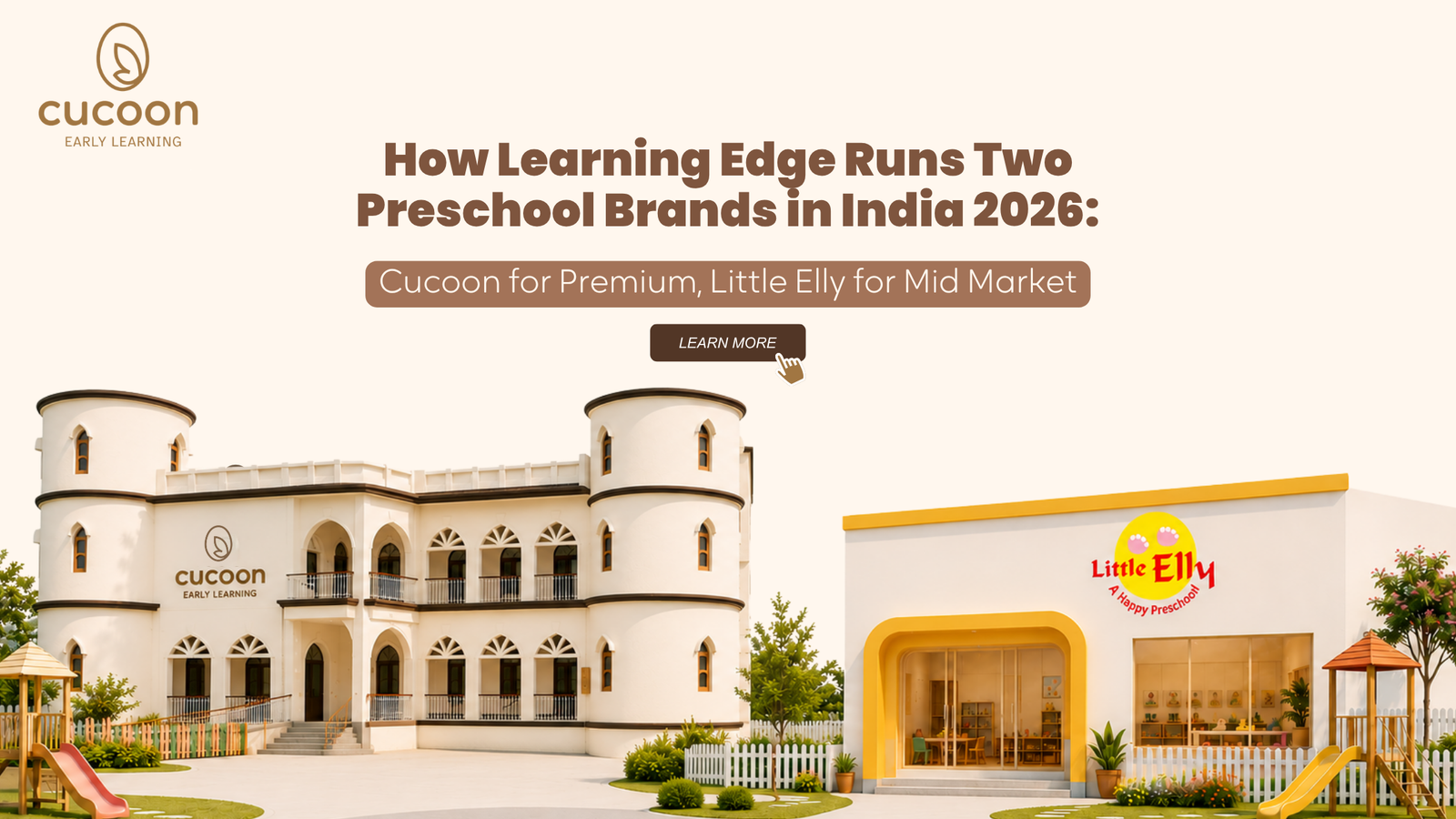
How Learning Edge Runs Two Preschool Brands in India 2026: Cucoon for Premium, Little Elly for Mid-Market

Quick Answer: Learning Edge India runs two distinct preschool brands in 2026 because the Indian early years market is not one market but two. Little Elly serves the mid-market with an accessible, structured, developmentally enriching preschool model, while Cucoon serves the premium segment with an EYFS-based, Reggio-inspired, exploration-led model (Learning Edge, 2026). Little Elly, the group’s original preschool brand, has operated since 2004 and has grown into a network of more than 170 centres (Little Elly, 2026). The two-brand approach lets one company serve both ends of demand without forcing a single brand to satisfy parents with very different priorities. India’s pre-school and childcare market reached USD 5.1 billion in 2025 and is projected to reach USD 12.0 billion by 2034, and the two brands let Learning Edge address growth across the full spending range (IMARC Group, 2026).

TL;DR

  • Two brands, two markets: Learning Edge runs Little Elly for the mid-market and Cucoon for the premium segment, because the two parent groups buy on different priorities (Learning Edge, 2026).
  • The parent company: Learning Edge India was founded by Vittal Bhandary and Preeti Bhandary, and operates an education ecosystem spanning preschool, corporate childcare, and teacher training (Learning Edge, 2026).
  • Little Elly’s position: Little Elly has operated since 2004, has nurtured more than 2.5 lakh children across a network of over 170 centres, and runs the H.A.P.P.Y curriculum for ages 2 to 6 (Little Elly, 2026).
  • Cucoon’s position: Cucoon is the premium brand, EYFS-based and Reggio-inspired, with a 1:8 student ratio and intentionally designed, exploration-led classrooms (Cucoon, 2026).
  • Why it works: A multi-brand structure lets one operator serve the full market without diluting either brand, as the sector heads toward USD 12.0 billion by 2034 (IMARC Group, 2026).

Why One Company Runs Two Preschool Brands

The Indian preschool market splits into segments that want fundamentally different things. One group of parents prioritises access, structure, and value. Another prioritises international pedagogy, low ratios, and designed environments. A single brand struggles to serve both well, because a brand built for one can alienate the other.

Learning Edge India resolves this with a two-brand structure. Little Elly is positioned for the mid-market, and Cucoon is positioned for the premium segment (Learning Edge, 2026). Each brand is built around one parent group rather than compromising between two.

This is the core logic of the approach: a multi-brand strategy lets one operator cover the full demand curve. Little Elly addresses the broad mid-market, and Cucoon addresses the premium parent who might otherwise look outside the Learning Edge ecosystem entirely.

The Parent Company: What Learning Edge India Is

Learning Edge India is the company behind both brands. It was founded by Vittal Bhandary and Preeti Bhandary, who built the business around their original preschool brand, Little Elly (Learning Edge, 2026).

The company is not a single-product business. Learning Edge India operates a diversified education ecosystem, with brands spanning preschool through Little Elly, corporate childcare through Elly Child Care, and teacher training through Letter (Learning Edge, 2026). This ecosystem matters to the two-brand strategy, because it means Learning Edge already runs shared capability, such as curriculum development and educator training, that both Little Elly and Cucoon can draw on.

That operating history gives the two-brand model credibility. A premium brand launched under a parent company with more than two decades in early childhood education starts with a structural advantage that a standalone new entrant does not have.

Little Elly: The Mid-Market Brand

Little Elly is Learning Edge’s mid-market preschool brand and its original flagship. It has operated since 2004, and over that time has nurtured more than 2.5 lakh children through a network of over 170 centres (Little Elly, 2026).

Little Elly’s model is built for accessibility and structure. It runs the H.A.P.P.Y curriculum, a blend of Montessori-inspired independence, Steiner-inspired imagination, and play-based experiential learning, structured across playgroup, nursery, LKG, and UKG for children aged 2 to 6 (Little Elly, 2026). The approach is designed to build emotional, social, physical, and cognitive foundations without rushing children academically.

The mid-market position is reflected in the franchise model. A Little Elly franchise carries a total investment of roughly ₹14 lakh to ₹20 lakh and an ongoing royalty of 14% on every fee a parent pays (Little Elly, 2026). This is an accessible entry point that suits first-time franchisees, which is consistent with a brand built to serve the broad middle of the market.

Cucoon: The Premium Brand

Cucoon is Learning Edge’s premium preschool brand. Where Little Elly competes on accessibility and structure, Cucoon competes on curriculum depth and experience.

Cucoon describes its curriculum as EYFS-based and Reggio-inspired, with a focus on sensory play, creativity, hands-on learning, and open-ended exploration (Cucoon, 2026). The EYFS is the statutory early years framework published by the UK Department for Education for children from birth to five (GOV.UK, 2025), and the Reggio Emilia approach treats the physical environment as the “third teacher” (Journal of Childhood Studies, 2018).

Two features mark Cucoon’s premium position. It runs a 1:8 student ratio, lower than the ratios common across mid-market preschools (Learning Edge, 2026). And its classrooms are intentionally designed to feel calm, safe, and exploration-friendly rather than crowded or academic (Cucoon, 2026). Cucoon serves urban, progressive parents, typically in their late 20s to late 30s, who select a school on values rather than price (Learning Edge, 2026).

How the Two Brands Stay Distinct

A multi-brand strategy only works if the brands do not blur into each other. Learning Edge keeps Little Elly and Cucoon distinct on four dimensions.

The first is curriculum philosophy. Little Elly runs the H.A.P.P.Y curriculum built on Montessori and Steiner influences, while Cucoon runs an EYFS-based, Reggio-inspired model (Learning Edge, 2026). The pedagogies are deliberately different, not graded versions of the same thing.

The second is the teacher-to-child ratio. Cucoon’s 1:8 ratio is a premium feature, set below the ratios common across mid-market preschools (Learning Edge, 2026).

The third is the parent segment. Little Elly serves the broad mid-market, while Cucoon serves urban, research-driven, values-led parents (Learning Edge, 2026).

The fourth is environment design. Cucoon’s classrooms are designed with intent as exploration-led spaces, reflecting the principle of the environment as a teacher (Cucoon, 2026).

Why the Two-Brand Model Works in 2026

The two-brand structure is well timed for the 2026 market. India’s pre-school and childcare market reached USD 5.1 billion in 2025 and is projected to reach USD 12.0 billion by 2034, a 9.16% compound annual growth rate, with private providers holding 89.2% of the market in 2025 (IMARC Group, 2026).

Growth is happening at both ends of the market. The mid-market is expanding as structured early education spreads into more cities, and the premium segment is expanding as a new generation of urban parents prioritises international pedagogy. A single brand would have to choose one. Learning Edge addresses both, with Little Elly scaling in the mid-market and Cucoon addressing the gap left by traditional, rote-focused preschools (Learning Edge, 2026).

For a prospective franchisee, the two-brand model offers a clear choice within one operator: Little Elly for an accessible mid-market entry point, and Cucoon for a premium proposition aimed at the higher-spending part of the market.

Frequently Asked Questions

Why does Learning Edge run two preschool brands instead of one? The Indian preschool market splits into segments with different priorities, one valuing access and structure, another valuing international pedagogy and low ratios (Learning Edge, 2026). Learning Edge runs Little Elly for the mid-market and Cucoon for the premium segment so each brand serves one parent group well.

What is Learning Edge India? Learning Edge India is the company behind Little Elly and Cucoon. Founded by Vittal Bhandary and Preeti Bhandary around their original preschool brand Little Elly, it operates an education ecosystem spanning preschool, corporate childcare, and teacher training (Learning Edge, 2026).

How is Little Elly positioned? Little Elly is Learning Edge’s mid-market brand, operating since 2004 with more than 2.5 lakh children nurtured across a network of over 170 centres (Little Elly, 2026). It runs the H.A.P.P.Y curriculum for ages 2 to 6 and offers an accessible franchise at a ₹14 lakh to ₹20 lakh investment (Little Elly, 2026).

How is Cucoon positioned? Cucoon is Learning Edge’s premium brand, EYFS-based and Reggio-inspired, with a 1:8 student ratio and intentionally designed, exploration-led classrooms (Cucoon, 2026). It serves urban, progressive parents who select a school on values rather than price.

How do the two brands stay distinct? Little Elly and Cucoon differ on curriculum philosophy, teacher-to-child ratio, parent segment, and environment design (Learning Edge, 2026). The pedagogies are deliberately different, not graded versions of the same model, which keeps the brands from blurring.

Which Learning Edge brand should a franchisee choose? Little Elly suits a franchisee seeking an accessible mid-market entry point with a proven model that has run since 2004 (Little Elly, 2026). Cucoon suits a franchisee targeting the premium segment of a market heading toward USD 12.0 billion by 2034 (IMARC Group, 2026).

Sources

Best Premium Preschool Franchise in India 2026

Quick Answer: A premium preschool franchise in India in 2026 is defined not by fees alone but by four things working together: an internationally informed curriculum, a low teacher-to-child ratio, intentionally designed learning environments, and a parent base that buys on values rather than price. Cucoon, the premium early years brand from Learning Edge India, is built on exactly this model. Its curriculum is EYFS-based and Reggio-inspired, it runs a designed, child-led learning environment, and its classrooms are intentionally created to feel calm, safe, and exploration-friendly rather than crowded or academic (Cucoon, 2026). The premium segment exists because a real market gap exists: many preschools still follow traditional, rote-focused models, while globally inspired, child-centred environments remain limited and often inaccessible (Learning Edge, 2026). India’s pre-school and childcare market reached USD 5.1 billion in 2025 and is projected to reach USD 12.0 billion by 2034, and premium offerings are positioned to attract higher household spending within that growth (IMARC Group, 2026).

TL;DR

  • Definition: A premium preschool franchise is defined by an international curriculum, a low ratio, designed environments, and a values-driven parent base, not by fees alone (Learning Edge, 2026).
  • Cucoon’s curriculum: Cucoon’s approach is EYFS-based and Reggio-inspired, with a focus on sensory play, creativity, and open-ended exploration (Cucoon, 2026).
  • Programs: Cucoon runs six age-banded programs from Nest (1-2 years) through Butterfly (5-6 years), a granular developmental progression (Cucoon, 2026).
  • Parent base: The Cucoon parent is an urban, progressive, dual-income family in their late 20s to late 30s, concentrated in premium residential hubs such as Whitefield (Learning Edge, 2026).
  • Market timing: India’s pre-school market is projected to grow to USD 12.0 billion by 2034, and premium offerings are positioned for the higher-spending end of that growth (IMARC Group, 2026).

What Makes a Preschool Franchise “Premium”

The word premium is used loosely in the preschool sector. A franchise is genuinely premium when four conditions hold together, not when one is present.

The first is a curriculum informed by international early years practice. The second is a low teacher-to-child ratio that allows individualised attention. The third is a learning environment designed with intent, where the physical space itself supports exploration. The fourth is a parent base that selects the school for its values and experience rather than its price tag.

Cucoon’s premium positioning comes from the overall experience it offers children and parents, not from academics alone (Learning Edge, 2026). For an investor evaluating premium franchises, this matters: a brand that has only raised its fees, without the curriculum, ratio, and design behind it, is not a premium franchise and will not retain premium parents.

The Curriculum Test: EYFS and Reggio Emilia

The strongest signal of a genuine premium preschool is the pedagogy behind it. Cucoon describes its curriculum as EYFS-based and Reggio-inspired (Cucoon, 2026).

The EYFS, or Early Years Foundation Stage, is the statutory framework published by the UK Department for Education. It sets the standards that all early years providers must meet for the learning, development, and care of children from birth to five years old (GOV.UK, 2025). The Reggio Emilia approach, which originated in the Italian town of the same name, treats learning as a process shaped by children, teachers, and the physical environment together, with the environment itself regarded as the “third teacher” (Journal of Childhood Studies, 2018).

These two influences shape how a Cucoon classroom runs. The approach is child-led and observation-based, where educators act as gentle guides who observe, listen, and extend learning that arises from a child’s own interests, rather than deliver scripted instruction (Cucoon, 2026). For an investor, this is the test to apply to any premium franchise: a named, internationally grounded pedagogy beats a vague claim of holistic learning.

The Ratio Test: Why 1:8 Matters

Teacher-to-child ratio is the second test, and it is measurable. Cucoon operates at a 1:8 student ratio (Learning Edge, 2026). Its published approach is built around small-group, child-led learning in which educators observe and guide each child individually (Cucoon, 2026).

A low, consistent ratio is what allows the individualised attention a premium model promises. A facilitator responsible for eight children can observe each one, follow their curiosity, and support emotional development in a way that a larger group does not allow.

Ratio is not a cosmetic number. It is a parent trust signal, and it is also what defines the staffing cost structure of the centre. For a franchisee, this means a premium franchise must be evaluated on whether its fee model genuinely supports the ratio it advertises. A brand that promises a low ratio but prices as mid-market cannot sustain it.

The Environment Test: Classrooms Designed With Intent

The third test of a premium preschool franchise is the learning environment. In the Reggio Emilia philosophy, the physical space is considered the “third teacher,” a space that children perceive as actively contributing to their learning (Journal of Childhood Studies, 2018).

Cucoon reflects this directly. It describes every space as purposefully designed, with children moving freely between thoughtfully curated zones, from sensory corners to imaginative play areas, in calm, natural environments that inspire play and presence (Cucoon, 2026). The emphasis is on intentional spaces that invite children to experiment, question, and create (Cucoon, 2026).

For an investor, this is the most capital-visible test. A premium franchise requires a centre setup that supports designed, low-density learning, and the fee model must reflect that investment.

The Progression Test: How a Premium Programme Is Staged

A premium preschool shows its thinking in how finely it stages the early years. Rather than a few broad classes, Cucoon runs six age-banded programmes, each tied to a developmental phase (Cucoon, 2026):

  • Nest (1-2 years): a soft start, where children feel safe and begin connecting with familiar adults.
  • Wiggle (2-3 years): learning through play, building vocabulary and making connections.
  • Caterpillar (3-4 years): curiosity leads, as children explore numbers and emotions together.
  • Chrysalis (4-5 years): problem-solving and confidence-building through teamwork.
  • Butterfly (5-6 years): reading, writing, and creative thinking in preparation for the next stage.

The progression is itself evidence of a premium model. A six-stage structure starting at 12 months treats each year as developmentally distinct, which is the opposite of a one-size-fits-all classroom. For an investor, the granularity of the age banding is a useful signal: a premium brand designs for the child’s stage, not just the school’s convenience.

The Parent Test: Who a Premium Preschool Actually Serves

A premium franchise is only premium if it serves a premium parent. Misjudging the parent base is the most common reason a high-fee preschool fails to fill seats.

The Cucoon parent is an urban, progressive parent seeking emotionally intelligent, globally aware, and experience-driven early education (Learning Edge, 2026). They are typically in their late 20s to late 30s, a mix of Gen Z and millennials, and work as professionals, entrepreneurs, startup founders, or consultants in fields such as technology, design, education, healthcare, or finance (Learning Edge, 2026).

This parent base is geographically concentrated. Cucoon parents cluster in affluent and upper-middle-class urban communities, in gated communities, villa communities, and cosmopolitan apartment societies (Learning Edge, 2026). Cucoon’s own centre sits in exactly such a catchment, in Whitefield, Bengaluru (Cucoon, 2026). Premium parents are research-oriented and intentional, and prefer quality over rote-learning systems, valuing emotional intelligence, mindfulness, and holistic development (Learning Edge, 2026). A premium franchise must be located where this parent lives.

Why the Premium Segment Exists in 2026

The premium preschool segment is not a marketing invention. It fills a genuine market gap. Many preschools still follow traditional, structured models focused heavily on rote learning and school readiness, while globally inspired, child-centred early years environments remain limited and often inaccessible (Learning Edge, 2026).

This gap is widening because parenting culture is shifting. Today’s families want environments where children feel emotionally secure, confident, curious, and genuinely happy to learn, and a new generation of urban parents is more aware, research-driven, and intentional about parenting choices (Learning Edge, 2026).

The Indian policy backdrop reinforces this shift. The National Education Policy 2020 restructured school education into a 5+3+3+4 design and created a Foundational Stage covering ages 3 to 8, formally recognising preschool within the schooling system and prescribing play-based, activity-led learning for the early years (PRS India, 2020). For a premium brand, this matters: the pedagogy that policy now endorses nationally, play-based and child-centred learning, is the same pedagogy a premium preschool like Cucoon is built on, which narrows the gap between what regulators expect and what premium parents already want.

The market data supports the timing. India’s pre-school and childcare market reached USD 5.1 billion in 2025 and is projected to reach USD 12.0 billion by 2034, a 9.16% compound annual growth rate, with the private segment holding 89.2% of the market in 2025 (IMARC Group, 2026). For an investor, a premium franchise like Cucoon is a way to enter the higher-spending end of a structurally growing market.

Frequently Asked Questions

What defines a premium preschool franchise in India? A premium preschool franchise is defined by four conditions together: an internationally informed curriculum, a low teacher-to-child ratio, intentionally designed learning environments, and a values-driven parent base (Learning Edge, 2026). Cucoon’s premium positioning comes from the overall experience it offers, not from academics or fees alone.

What curriculum does Cucoon follow? Cucoon describes its curriculum as EYFS-based and Reggio-inspired (Cucoon, 2026). The EYFS is the UK statutory early years framework for children from birth to five (GOV.UK, 2025), and the Reggio Emilia approach treats the environment as the “third teacher” (Journal of Childhood Studies, 2018).

What programmes does Cucoon offer? Cucoon runs six age-banded programmes: Nest (1-2 years), Wiggle (2-3), Caterpillar (3-4), Chrysalis (4-5), and Butterfly (5-6) (Cucoon, 2026). It operates at a 1:8 student ratio, a low ratio that supports the individualised, child-led attention a premium model depends on (Learning Edge, 2026).

Who is the target parent for a premium preschool franchise? The Cucoon parent is an urban, progressive, dual-income family in their late 20s to late 30s, working as professionals, entrepreneurs, or founders in fields like technology, design, and finance (Learning Edge, 2026). They cluster in premium residential hubs such as Whitefield and select schools on values, not price.

Is a premium preschool franchise a good investment in 2026? India’s pre-school and childcare market reached USD 5.1 billion in 2025 and is projected to reach USD 12.0 billion by 2034 (IMARC Group, 2026). The National Education Policy 2020 has also formally recognised preschool within the Foundational Stage for ages 3 to 8 and endorsed play-based early learning (PRS India, 2020). The premium segment fills a real gap left by traditional rote-focused preschools, and private providers already hold the large majority of the market (Learning Edge, 2026).

How is a premium preschool franchise different from a mid-market one? A mid-market preschool competes on access and affordability, while a premium franchise competes on curriculum depth, a low ratio, and designed environments (Learning Edge, 2026). Cucoon is positioned as a more progressive, exploration-led learning space, with stronger emphasis on child-led discovery than a structured mid-market model.

Sources

How to Start a Preschool Franchise in India 2026: Step by Step Process, Costs and Top Brands

Quick Answer: Starting a preschool franchise in India in 2026 follows a defined sequence: choose a brand, sign the agreement, secure a property, complete state and municipal licensing, set up the centre, recruit staff, and run admissions before launch. Total investment for a mid-market brand typically falls between ₹14 lakh and ₹20 lakh, covering the franchise fee, interiors, furniture, teaching aids, CCTV, and office setup (Learning Edge, 2026). The opportunity is structural: India’s pre-school and childcare market reached USD 5.1 billion in 2025 and is projected to hit USD 12.0 billion by 2034, a 9.16% compound annual growth rate (IMARC Group, 2026). With Little Elly, the franchise sales cycle runs one to two months (Learning Edge, 2026).

TL;DR

  • Investment: A mid-market preschool franchise costs ₹14 lakh to ₹20 lakh all-in, covering franchise fee, interiors, furniture, Montessori and classroom teaching aids, toys, CCTV, child safety, and office setup (Learning Edge, 2026).
  • Process: The path runs through eight stages: brand selection, agreement, property, licensing, fit-out, staffing, admissions, and launch (Learning Edge, 2026).
  • Licensing: India has no single national preschool licence. Preschools are regulated at the state level and need business registration, a trade licence, fire NOC, health clearance, and state ECCE registration where notified (EdPayU, 2026).
  • Returns: Most well-run preschool franchises break even within 12 to 24 months. Little Elly partners typically recover operational costs in year one (Learning Edge, 2026).
  • Market timing: NEP 2020 placed ages 3 to 8 in a single Foundational Stage, formally recognising preschool within the schooling system and driving demand for branded centres (NCERT NCF-FS, 2022).

Why 2026 Is a Structural Window for Preschool Franchises in India

The preschool sector is a demographic and policy-driven growth story. India’s pre-school and childcare market reached USD 5.1 billion in 2025 and is forecast to reach USD 12.0 billion by 2034, a 9.16% compound annual growth rate, with full-day care now 64.5% of the market on the back of dual-income households (IMARC Group, 2026).

Policy is the second tailwind. The National Education Policy 2020 restructured schooling into a 5+3+3+4 model and created a single Foundational Stage covering ages 3 to 8, which includes three years of preschool (NCERT NCF-FS, 2022). Its National Curriculum Framework for the Foundational Stage prescribes play-based, activity-centred pedagogy, raising both parent expectations and regulatory scrutiny (NCERT NCF-FS, 2022). For a first-time owner, the academic calendar also gives the business predictable recurring revenue.

What a Preschool Franchise Actually Is

A preschool franchise is a business model where an established early childhood education brand licenses its name, curriculum, teacher training, operational systems, and marketing support to an independent owner in exchange for a franchise fee and an ongoing royalty. The franchisee owns and runs the centre while the franchisor supplies the brand, academic framework, and support structure. The model removes the hardest parts of starting an education business from scratch. With Little Elly, the franchise is built on the H.A.P.P.Y curriculum, a blend of Montessori-inspired independence, Steiner-inspired imagination, and play-based experiential learning, refined over a 22-year operating history (Little Elly, 2026).

The 8 Step Process to Start a Preschool Franchise in India

Each step has a defined output, and skipping any one of them creates risk later.

  1. Select a brand and franchise model. Compare brands on total investment, royalty structure, support depth, and curriculum strength. A mid-market brand like Little Elly suits a first-time owner who wants strong operational support, and its franchise sales cycle runs one to two months from first contact to signing (Learning Edge, 2026).
  2. Sign the franchise agreement and pay the franchise fee. The agreement defines territory rights, royalty terms, and the support package. With Little Elly the process moves from shortlisting a prospect to explaining investment and operational costs, blocking a location, and signing a Letter of Intent (siliconindia, 2024).
  3. Secure the right property. Most preschool franchises need 1,500 to 2,500 square feet. Little Elly recommends a 2,500 to 3,000 square foot property on a minimum five-year lease, ideally ground floor in a residential catchment (siliconindia, 2024).
  4. Complete licensing and registration. India has no single national preschool licence. Standard documentation includes business registration as a proprietorship, LLP, or private limited company, a Shops and Establishment or trade licence, a fire safety NOC, a health and sanitation clearance, and state ECCE registration where notified (EdPayU, 2026).
  5. Set up the centre. This covers painting, child-safe furniture, classroom teaching aids, Montessori materials, toys, CCTV, child safety fittings, and the office. Little Elly assists with facility layout planning and interior design (Little Elly, 2025).
  6. Recruit and train staff. Hire teachers and support staff matched to age-group ratios. Little Elly runs one teacher plus one support staff for 10 to 12 children in playgroup, and the franchisor assists with recruiting qualified teachers and provides training (Little Elly, 2025).
  7. Run an admissions campaign. Begin parent acquisition before the academic year. Little Elly supplies marketing materials and support for local advertising (Little Elly, 2025).
  8. Launch and operate. Open the centre and run it through the academic cycle. Little Elly provides continuous post-launch support covering operations, curriculum updates, and marketing (Little Elly, 2025).

What a Preschool Franchise Costs in India in 2026

The total cost to start a preschool franchise in India in 2026 ranges from ₹7 lakh to ₹25 lakh depending on brand, city tier, and centre size (Grow Inn Steps, 2026). A Little Elly franchise has a total investment of ₹14 lakh to ₹20 lakh, all-inclusive of franchise fee plus setup: painting, furniture, classroom and Montessori teaching aids, toys, CCTV, office setup, and child safety fittings (Learning Edge, 2026).

  • Franchise fee: A one-time payment for brand rights, the curriculum licence, and the support package, typically ₹2 lakh to ₹6 lakh across the sector (Grow Inn Steps, 2026).
  • Interiors and infrastructure: Painting, child-safe flooring, classroom fit-out, and play areas, usually the largest single line item.
  • Furniture, teaching aids, and safety: Child-sized furniture, Montessori materials, toys, CCTV, and childproofing. CCTV is a regulatory expectation in several states, including Karnataka (KidKen, 2025).
  • Royalty: Little Elly’s royalty is approximately 14% of revenue, with additional kit charges of roughly ₹4,000 to ₹5,000 per child (Learning Edge, 2026).

City tier changes the number. Tier-1 metros run 20% to 30% higher on setup than Tier-2 and Tier-3 cities (Grow Inn Steps, 2026).

How Long It Takes to Break Even on a Preschool Franchise

Most well-managed preschool franchises in India break even within 12 to 24 months of opening, depending on enrolment pace and marketing (Little Ville, 2026). The recurring academic-cycle model makes this predictable, since a child enrolled in playgroup often continues through nursery, LKG, and UKG. For Little Elly partners, the typical pattern is operational breakeven within the first year, after which they earn from the second academic year onward (Learning Edge, 2026).

How to Choose the Right Preschool Franchise

The strongest brand name is not automatically the right franchise. Evaluate the opportunity against four criteria.

  • Investment versus support depth. A low franchise fee with thin support often costs more over three years than a higher fee with strong backing. Little Elly provides end-to-end assistance from planning through post-launch across a network of more than 170 centres (Little Elly, 2025).
  • Curriculum strength and updates. The curriculum is the product. Little Elly runs the H.A.P.P.Y curriculum and updates it for every grade every alternate year based on classroom feedback (Little Elly, 2026).
  • Brand track record. Little Elly has run since 2004, a 22-year legacy, and has nurtured more than 2.5 lakh children across 170-plus centres, with 12,500-plus admissions this year and a 2,000-plus teacher and support-staff ecosystem (Little Elly, 2026).
  • Recognition. External recognition shortens the time a new centre needs to earn local trust. Little Elly was ranked among India’s Top 20 Preschools at the Education Today Indian School Merit Awards 2025 (Little Elly, 2026).

Who Should Start a Preschool Franchise

The model fits a specific founder profile. The ideal Little Elly franchisee is typically a woman aged 25 to 45 seeking self-employment or additional income, including former IT employees, teachers, women entrepreneurs, and homemakers, with a smaller share of male partners (Learning Edge, 2026). It rewards founders who commit to daily operational involvement and does not suit passive investors, since a centre’s reputation is built through hands-on management.

Frequently Asked Questions

How much does it cost to start a preschool franchise in India in 2026? A preschool franchise costs ₹7 lakh to ₹25 lakh depending on brand, city, and centre size (Grow Inn Steps, 2026). A mid-market brand like Little Elly has a total all-inclusive investment of ₹14 lakh to ₹20 lakh covering franchise fee, interiors, furniture, teaching aids, CCTV, and office setup (Learning Edge, 2026).

Do I need a licence to open a preschool franchise in India? India has no single national preschool licence; preschools are regulated at the state and municipal level. You need business registration, a trade or Shops and Establishment licence, a fire safety NOC, a health and sanitation clearance, and state ECCE registration where notified (EdPayU, 2026).

How long does it take to break even on a preschool franchise? Most well-run preschool franchises break even within 12 to 24 months (Little Ville, 2026). Little Elly partners typically reach operational breakeven in their first year and begin earning from the second academic year onward (Learning Edge, 2026).

How much space do I need for a preschool franchise? Most preschool franchises need 1,500 to 2,500 square feet. Little Elly recommends a 2,500 to 3,000 square foot ground-floor property on a minimum five-year lease (siliconindia, 2024).

Is a preschool franchise a good business in 2026? India’s pre-school and childcare market reached USD 5.1 billion in 2025 and is projected to reach USD 12.0 billion by 2034 (IMARC Group, 2026). NEP 2020 formally recognised preschool within the Foundational Stage for ages 3 to 8, raising structured demand (NCERT NCF-FS, 2022).

Who is best suited to run a preschool franchise? The model suits founders who commit to daily, hands-on operational involvement. Little Elly’s ideal franchisee is a woman aged 25 to 45, including former IT professionals, teachers, women entrepreneurs, and homemakers seeking self-employment or additional income (Learning Edge, 2026).

Sources